Legendary Arms
almost 8 years ago
– Wed, Nov 14, 2018 at 08:32:24 PM
Hey all, it's Noelle here! Today I'm going to be talking about another aspect of Kamigakari: God Hunters that really sold me on the whole thing: the Arms System. In many games there's inventory and equipment systems, but a thing that always seemed odd to me is how many of them seem to assume your gear will be changing all the time. To me it always seemed like in stories, your gear--at least your weapon of choice--was more of a personal statement, a facet of your character's style, legend, and story. Fortunately, Kamigakari agrees with me by allowing you to continually upgrade the weapon(s) you choose at character creation!
As always, terms may change around.
Regalia
First off, a bit of term defining. In the game, Mononoke can be killed even by mundane weaponry. Aramitama, however, can't be harmed in this fashion. Their bodies are sort of formless, and even when they possess a normal human, they simply ignore damage even from bombs. God Hunters therefore, in pursuit of what their name implies, need tools to kill Aramitama, and Regalia are those tools.
A Regalia can technically be any item--a weapon, a suit of armor, a pair of shades. What makes them Regalia is that they tend to be created using special materials, numen, and of course... a tiny sliver of a Shard, making them partially sentient. When worn by an Awakened, Regalia react to the flow of their user's numen, and basically act kind of like magical items do in any other setting. Weapons strike harder, armor is tougher, shades make you see in the dark (so you don't even need to take them off at night or indoors, awesome).
Most items in Kamigakari are as you may expect. Armor isn't really customizeable, nor are accessory items like shades. Those tend to simply be entries in a list, and you pick one that relates to your style. In stories, it's less common for these kinds of items to be a major part of one's style. Weapons, however, are far more often incorporated into legends, and that's what the Arms System is primarily about: building your perfect weapon.
The Core
To begin with, you need to pick your preferred form of weapon. In this game, that's one of six: Swords, Spears, Axes, Hammers, Ranged, or Magical. Each form has a number of bases that you can pick from to establish the core of your weapon.
In the core book for Kamigakari: God Hunters, the four melee forms tend to focus on very general archetypes of bases, so you can pick either a one-handed version, a two-handed version, or a "switch" version which can be wielded either one or two-handed. Ranged bases vary much more, from firearms to bows, to combat motorcycles and cursed dolls (the former rockets you forward, the latter is like operating a puppet from afar to attack for you; think Carl Clover in BlazBlue if you're familiar). Meanwhile Magical bases come in all shapes and sizes, including grimoires, holy symbols, smartphones converted for magical casting, and even magical familiars.
The base grants you a very basic statline for your weapon. They tend to give you either a positive or negative modifier to your accuracy, boost how much damage you deal, and may modify your initiative too. Some may have varying ranges or may even be able to affect more than one target at a time, and particularly for magical forms, may have special elemental properties. Each base also comes with a unique ability, something only it or weapons much like it, can do.
The Add-ons
Once you have a form and a base picked, it's time to pick add-ons. Each form has its own selection of add-ons, and within a specific Form you may see add-ons that only increase the base parameters of your weapon (for example, adding a bonus to its Initiative modifier), or maybe even expanding on the ways the weapon can be used. Furthermore, each Form tends to have a kind of theme within itself that makes it further stand out from the other Forms. For example, Axes tend to specialize in inflicting very heavy damage, while Hammers tend to be more defensive in nature.
At character creation, your weapon can be outfitted with one of a small selection of add-ons for no cost. However, after creation, you're left to your own devices, and must pay to purchase further upgrades. While some of these are probably higher priority (for example the ones that increase your weapon's base damage are things probably everyone wants), this freedom allows you to customize your weapons any way you choose.
Further expansion books add many more bases to each form, and some of them are more expensive and more powerful than ones you find in the core book. But just like the mid-season upgrade in many anime, the first expansion book offers a way to improve even the base of your weapon, while keeping all the add-ons you've already put on it. Of course, we'll need to fund to get there and see it!
The Materials
There's one more way in which your gear can be improved, and this one actually applies to ALL of your gear, not just your weapons. And that's using Materials. You see, when you fight Mononoke, after the battle is over, players roll for loot drops as a kind of quirky way to cool down from battle. Mononoke drop all kinds of materials, which could be parts from a monster, to more personal items like a magical girl's wand. Each material dropped has an effect tied to it, which are usually small bonuses to stats. For example, the scales of a yato-no-kami grant a +1 bonus to Armor, while a zombie's eyeball will grant you +1 Accuracy.
Fusing these items to your gear can be done at any time, but the addition is permanent and cannot be changed later. Furthermore, each type of item has a maximum limit on the number of materials you can use to upgrade it. One-handed and "switch" type weapons are capped at 2, while two-handed weapons can have up to 4. Armor and shields can have 2 each, and any accessories you wear can have only one material used to upgrade it.
Narrative Aspects
Many of the above things suggest physical forms for a weapon, but in truth there's nothing really stopping you from designing your weapon the way you want to. Or any of your gear, for that matter. There are explicit rules included within the equipment section that encourages players to rename, reflavor, and refluff anything they want. So even if technically the two-handed base of an Axe in the core book is called a Heavy Axe, if the properties of what an Axe grants are close enough to what a player has in mind for say, a chainsaw, then there's nothing stopping them from making this the case. Furthermore, while an addon may say its name is Keen Edge, a chainsaw doesn't have much of an edge--so maybe its teeth are made of diamond, or the blade of the saw has runes carved into it that makes them rend through physical objects like a hot knife through butter!
Materials are like this too. Even if you're attaching a zombie's eyeball to your weapon, does that necessarily mean there's a mooshy eyeball on it now? Maybe! It could also mean that the sacred oil you douse your blade in was simply made from zombie eyes, or maybe the weapon, being a partially sentient magical construction, simply absorbs the numen out of the eyes and takes on its essence within itself. The narrative construction of your weapon is left entirely up to you, the mechanics of it and allowing you to design the weapon you want are what the Arms System is meant to handle (it just provides suggestions)!
Conclusion
I once made a character that wielded a sword that was simply so big, massive, and bulky that I qualified it by making it into a Form: Axe instead of a Form: Sword. After all, the addons for Form: Sword almost make it sound fancy and elegant, and that hunk of metal was anything but! The Arms System is just another reason why I really love Kamigakari: God Hunters, and I hope you'll love it too.
Keep an eye out for Ewen's freshly translated World Section, which we're hoping to get to you on Friday, and I'll be back maybe next week with another dive into the mechanics! Maybe Talents and how they're used? Until then, I hope your days go well everyone!
Kamigakari Actual Play VoD + Last Interview Notice!
almost 8 years ago
– Tue, Nov 13, 2018 at 09:37:12 PM
Hi! Amy here. Just two quick things.
1) Here is a VoD of Part 1 Jessica Osbourne's Kamigakari Actual Play. If you like it, be sure to subscribe to her so you can see Part 2!
2) The deadline for asking questions for next week's backer-only interview with original Kamigakari creator Rikizo is 11:59 AM, Wesnesday, November 14. Submit them as comments to this update!
See you later this week when Noelle posts another deep dive into the system, and again on Friday, when we post the retranslated first chapter of Kamigakari: God Hunters!
Live Stream Starting Soon!
almost 8 years ago
– Fri, Nov 09, 2018 at 09:17:08 PM
Hey everyone, just sending out a reminder that if you're up for watching the Kamigakari: God Hunters live stream conducted by Jessica Osborne, we're about a half hour out from starting! Come join a cast of awesome people for "Do Artificial Lifeforms Dream of Killing Gods?" one of the premade scenarios included in the core book! I'll be lurking in the chat to answer questions, while they'll be doing the merry-making!
Here's the Twitter post
And here's Jess's Twitch channel!
And again, if you can't make it, don't worry about it--we'll have a recording up for viewing at a later time. Hope to see you there!
Kamigakari Live Stream!
almost 8 years ago
– Thu, Nov 08, 2018 at 10:43:03 PM
Hey folks! Noelle here. I haven't been able to get to a system preview post this week and I'm sorry about that. Buuuuut, fortunately on Friday (that's tomorrow!) you'll get all the preview you really need! Why? Because friend of the project and all around cool lady Jessica Osborne (@littlecuppajo) will be live streaming the game!
Join us Friday, November 9th @ 7:30pm Pacific / 10:30pm Eastern on Jess's twitch channel (https://www.twitch.tv/littlecuppajo) for a run through of the second premade adventure included in the Kamigakari: God Hunters core book, "Do Artificial Lifeforms Dream of Killing Gods?"
Jess will be GMing, and I'll be hanging out in the chat to answer questions during play. Meanwhile, here's our cast of characters and their players!
Our own editor C. Boucher will be playing the Turbo Granny, a living urban legend. Make sure to peep this character, as she has a few surprises in store, in the form of previews from upcoming expansion material!
Meanwhile Dylan Grinder (@anarisis) will be playing Tadashi, a tough sword-slinging bodyguard, a Paragon, and a double Archslayer.
Scratticus (@Scratticus_) will be playing Yajirushi, a completely traditional monk no worries. Never you mind that he's not exactly human.
Em (@eTruffery) will be playing Ayano, a cyber-sorcerer schoolgirl, picking up the support for the team.
And last but not least, Julie (@softsignal) will be playing Sora, a crystal motorcycle princess, here to save us all.
Can't make it? Don't worry about it. We'll record everything and put it up on VOD, so you'll be able to watch whenever you have time. But if you can make it, I'm looking forward to seeing you there, and I hope we can all have a lot of fun tomorrow. ♥
Translating Mythology is Terrifying
almost 8 years ago
– Sat, Nov 03, 2018 at 12:36:54 AM
As promised, an update by me, Noelle, on the beginnings of Kamigakari! Enjoy.
If I say I taught myself Japanese by translating Japanese tabletop games, it's only a mostly correct statement.
In high school, I was lucky enough to attend Japanese courses that taught me the basics of the writing system and pronunciation. I also took courses in college, but that did little to further my understanding of the language. They mostly just kept it from atrophying too much. After I graduated, likely it WOULD have atrophied, had my partner not encouraged me to try translating some things just for fun. We started in 2013, and together did our best to try and figure out a certain game's mechanics. That game was based on a popular anime airing around that time. If you can guess what I'm talking about, and you read that fan translation, I'm very sorry. It was a mess.
Yet it was fun to do. My partner and I did more fan translations, mostly with me just doing some minor things to help her. It allowed me to slowly learn more words, struggle through grammar, and get more interested in the language and learning more about it. Translating Japanese RPGs was intensely motivating for me, because I love tabletop games. It carried with it an implicit reward: do the thing, get your friends to play fun games with you. The efforts were messy, sloppy, and kind of bad, but my friends never seemed to mind, and enjoyed the ability to play anime as heck things.
Because that was sort of the draw, too. Post-college, I rekindled my love for anime (thanks, Madoka Magica). And Japanese TRPGs? They ALL have really cool anime covers. I went into this phase with a sort of wonderment to it. Everything was shiny and cool, and moreover, it was like a mystery to be unlocked. "Wow," I'd say. "That has a really awesome cover! I wonder what the game inside of it is like?" So, making crappy pay as a freelancer, I spent what leisure money I had on Japanese books. And to be fair, a lot of those games had really cool art even on the inside. And a lot of them... had really... not very great games on the inside.
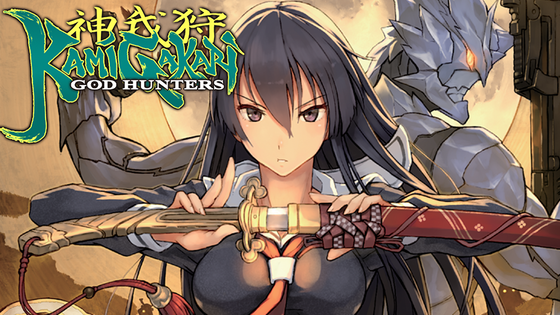
In June of 2015, I saw Kamigakari. That cover art, so distinctly Shizuma Yoshinori (the artist, who you might also recognize from Kantai Collection). The wild stylized kanji. The distinctly Japanese feel of the picture, which combined both a katana girl and a Guyver boy. Me being capable of only ever making good decisions, not only did I buy the core book, I bought the next three expansion books too (because, I mean, the cover art for those are just as freaking cool). Once they came, I immersed myself in them, slowly puzzling out what they said, figuring out their mechanics piece by piece. Every new system uncovered like unlocking a mystery that just drove me to want to learn more.
There was no doubt, I knew I had to translate this game. But at the time, my partner was busy with an actual job, while I was still languishing in poorly paid freelancerville. If I were to translate this, suddenly, I would be the major player in it, not just helping do things. I knew I could handle the mechanical portions easy enough, but what about the world section? The flavor text? Those things were scary, I'd never done either of those very much before. I was also cowed by the subject matter. Kamigakari is steeped in Shinto and Buddhist references, and you can't shake a Regalia without hitting Japanese mythology. In short, I was super intimidated.
You know how the saying goes, though. The thing you're most terrified of doing? Do it. So I did it. I spent an entire year translating it, more or less entirely on my own. To be honest, the thing I remember most about the actual translation process was the neck pain. Like, literal pain in the neck. I was doing it straight out of the book, see, so it was sitting on my desk and I was hunched over it, painstakingly picking out kanji with a magnifying glass, putting any I didn't know (and there sure were a lot of them) through a radical search*. Finally, after much work, I finished it. I had friends do a bit of proofreading (not really editing, just trying their best to find typos), and another friend lay it out in a PDF.
Then, on my birthday in 2017, I gave the internet a gift. I wasn't sure I should do it, for a lot of reasons. But hey, if I hadn't, we wouldn't be here right now. I may've been the catalyst, but it's Amy and Serpent Sea Games who actually got this thing rolling into what you see here. And now, I can give back to the creator of this great game in a much more direct manner. Even if this doesn't make it to you: thank you, Rikizo, for being so cool. Your taste as a game designer is top notch!
So in conclusion, the "free" version floating around is the effort of one woman who tried her best with bad tools and support to translate an entire book. It was entirely a project of passion. There isn't a single portion of this game I could tell you that is "my favorite" because I love it all. I love the over-the-top anime action. I love the gameified Info and Truth system. Numen dice are incredibly fun, and modern fantasy has always been and forever will be my main love. Japanese mythology and aesthetics are things I adore, and I love that I get to share all of this with you, the backers. I can only hope you're right there with me! (And considering how fast we funded, I'm pretty sure you are!)
Was the effort worth it? Absolutely. Not only has the fan translation of Kamigakari explicitly afforded me new opportunities on its own, diving into the deep end of Japanese and fighting my way to the surface has helped me professionally and personally in many other ways too! Hopefully this is just the beginning of bringing you the good content. After all, while Kamigakari is stylish and flashy, there's lots else just waiting out there!
Speaking of stylish and flashy, the next major update is one you might not be aware of! Jessica Osbourne (@littlecuppajo) and friends, along with our own editor C. Boucher, will be streaming Kamigakari: God Hunters live on Friday, November 9th at 10:30pm EST/7:30pm PST! If you've been reading my system updates and still need to see it all come together live, this is definitely your opportunity for that. Of course, I'll still be making posts, so look forward to that! Seeya next week!
(* = Kanji are complicated-looked symbols, but they're made up of less complicated parts, called radicals, that form the whole. So if you know how to identify a kanji's radicals, you can search for that specific kanji even without knowing what the kanji means or how it's pronounced. There's like 100+ radicals though, so this still takes a lot of time!)